Difference Between Civil and Criminal Cases in Pakistan (2025 Guide)

difference between civil and criminal cases in Pakistan

Difference Between Civil and Criminal Cases in Pakistan (2025 Guide)

difference between civil and criminal cases in Pakistan

Introduction

Difference between civil and criminal cases in Pakistan, In Pakistan’s legal system, every dispute or offence is categorized as either a civil case or a criminal case.
Understanding the difference between civil and criminal cases helps you choose the right court, lawyer, and legal remedy.

At GNS Law Associates, Karachi, we represent clients in both civil and criminal courts — helping individuals and businesses pursue justice effectively.

What Is a Civil Case in Pakistan?

A civil case is a dispute between two private parties — individuals, families, or businesses — over legal rights, money, or property.

Civil cases do not involve crimes, but focus on compensation, damages, or declarations.

Examples of civil cases:

  • Property or rent disputes

  • Recovery of money suits

  • Contract breaches

  • Family matters (divorce, custody, inheritance)

  • Defamation and injunction suits

Key Goal:
To protect or restore a person’s rights through court orders or compensation.

Civil Courts in Pakistan:

  • Civil Judge Courts

  • Family Courts

  • District Courts

  • High Courts (appeals)

What Is a Criminal Case in Pakistan?

A criminal case involves an act considered a crime under the Pakistan Penal Code (PPC) or special laws.
The State (Government) is always a party, and punishment may include imprisonment or fine.

Examples of criminal cases:

  • Theft, fraud, or forgery

  • Murder, assault, or harassment

  • Cheque bounce offences

  • Cybercrime under PECA 2016

  • Narcotics or smuggling cases

Key Goal:
To punish the offender and protect society from unlawful acts.

Criminal Courts in Pakistan:

  • Magistrate Courts (minor offences)

  • Sessions Courts (serious offences)

  • Special Courts (NAB, FIA, Anti-Terrorism, Cybercrime)

Main Difference Between Civil and Criminal Cases in Pakistan

Aspect   Civil Case    Criminal Case

Parties

 Private individuals or companies     State (Prosecution) vs Accused
ObjectiveCompensation, rights enforcement     Punishment, deterrence
Burden of ProofBalance of probabilities     Beyond reasonable doubt
ExamplesProperty, contract, family, recovery     Murder, theft, fraud, cybercrime
Courts  Civil / Family / District Courts     Criminal / Sessions / Special Courts
Law Civil Procedure Code (CPC)     Pakistan Penal Code (PPC), CrPC
ResultDecree, injunction, damages     Conviction, acquittal, imprisonment

When Should You File a Civil Case?

You should file a civil case when your rights or property are violated, but no crime has been committed.
For example:

  • Someone occupies your property illegally → File a Suit for Declaration or Possession.

  • Someone refuses to return your money → File a Suit for Recovery of Money.

Tip: Always send a legal notice before filing a civil case — it strengthens your position in court.

When Should You File a Criminal Case?

If an act causes harm, fraud, or danger to life or property, it’s a criminal matter.

  • Lodge an FIR at the local police station.

  • If police don’t act, file a Criminal Complaint under Section 200 CrPC through your lawyer.

Example: Cheque dishonoured → File complaint under Section 489-F PPC.

Key Takeaway

  • Civil cases = Rights & Compensation.

  • Criminal cases = Crimes & Punishment.

  • Both follow separate laws and court

civil vs criminal cases Pakistan, types of cases in Pakistan, civil court Karachi, criminal court Karachi, PPC vs CPC Pakistan

Contact Us Today!

At GNS Law Associates, Karachi, our team handles civil suits, family disputes, bail, and criminal defence cases professionally — for local and overseas clients.

FAQs – Civil vs Criminal Cases in Pakistan

What is the main difference between civil and criminal cases?

Civil cases involve private disputes over rights or property; criminal cases involve offences against the State.

Can one case be both civil and criminal?

Yes. Some matters, like cheque bounce or fraud, can lead to both civil and criminal proceedings.

Which law governs civil cases in Pakistan?


The Civil Procedure Code (CPC), 1908 governs civil proceedings.

Which law governs criminal cases?


The Pakistan Penal Code (PPC) and Criminal Procedure Code (CrPC) govern criminal trials.

How can GNS Law Associates help me?


We represent clients in Civil, Criminal, and Family Courts in Karachi — from legal notices to trial and appeals.

Criminal Complaints for Overseas Pakistanis

Criminal Complaints for Overseas Pakistanis

Criminal Complaints & Cybercrime Cases by Overseas Pakistanis: Complete Guide 2025

Criminal Complaints for Overseas Pakistanis

Introduction

Many Overseas Pakistanis face fraud, scams, property grabs, or online harassment in Pakistan while living abroad. Returning home for every complaint is impractical. Fortunately, Pakistani law allows overseas citizens to file criminal complaints and cybercrime cases through proper legal channels without traveling back.

This guide explains how overseas Pakistanis can pursue criminal complaints, FIR registration, and cybercrime cases in Pakistan using Power of Attorney, FIA, and legal representation in Karachi.

Types of Criminal Complaints Overseas Pakistanis Commonly Face

  • Property Grabbing & Illegal Possession 🏠

  • Financial Fraud & Cheating 💰

  • Forgery & Fraudulent Transfers 📝

  • Family & Domestic Violence Complaints 👨‍👩‍👧

  • Online Harassment / Cybercrime (Facebook, WhatsApp, Instagram, Emails) 💻

Filing Criminal Complaints in Pakistan

1. Registration of FIR (First Information Report)

  • An FIR can be lodged in the police station where the incident occurred.

  • Overseas complainants can appoint a lawyer or attorney via Power of Attorney.

  • Supporting documents and evidence should be submitted along with the complaint.

2. Role of Power of Attorney

  • Overseas complainants can avoid traveling back by executing a Special Power of Attorney at the Pakistan Embassy/Consulate.

  • The attorney (lawyer or relative) can file and follow up on the complaint in Pakistan.

3. Police & Court Process

  • Once an FIR is registered, police investigate.

  • If no action is taken, the complainant can approach the District & Sessions Court for directions.

Cybercrime Cases by Overseas Pakistanis

1. Role of FIA (Federal Investigation Agency)

  • Cybercrime complaints are handled by FIA Cyber Crime Wing under the Prevention of Electronic Crimes Act (PECA), 2016.

  • Complaints may include:

    • Social media defamation

    • Financial scams

    • Email/WhatsApp hacking

    • Blackmail or online threats

2. Filing Cybercrime Complaints

  • Overseas Pakistanis can file online complaints through the FIA Cybercrime Reporting Portal.

Recognition & Enforcement Abroad

  • Criminal judgments from Pakistani courts may assist in international proceedings.

  • Cybercrime complaints with evidence (emails, WhatsApp chats, transaction records) are admissible in foreign jurisdictions as supporting proof.

Why Hire a Lawyer in Karachi?

  • Ensures proper filing of FIRs and cybercrime complaints.

  • Drafts and registers Power of Attorney for overseas complainants.

  • Represents clients in police stations, FIA, and courts.

  • Prevents delays due to absence of complainant.

Contact Us Today!

For Overseas Pakistanis, filing criminal complaints or cybercrime cases in Pakistan is possible without traveling home. With the right Power of Attorney and professional representation, overseas clients can protect their rights, property, and reputation under Pakistani law.

criminal complaints overseas Pakistanis, cybercrime cases overseas Pakistanis, FIA cybercrime Pakistan expats, FIR filing for overseas Pakistanis, online fraud cases Pakistan expats, property fraud overseas Pakistanis, overseas Pakistani lawyer Karachi, cybercrime complaint portal FIA, power of attorney criminal cases Pakistan, legal help overseas Pakistanis

FAQs – Criminal Complaints for Overseas Pakistanis

Can an overseas Pakistani file an FIR in Pakistan?

Yes. Through Power of Attorney, a relative can file an FIR in Pakistan on their behalf.

How can overseas Pakistanis file cybercrime cases?

They can use the FIA’s online complaint portal or authorize a lawyer in Karachi to file with FIA Cyber Crime Wing.

What evidence is needed for cybercrime complaints?


Screenshots, chat records, transaction receipts, and witness statements can support the complaint.

Do overseas complainants need to appear in Pakistani courts?


No. Lawyers can represent them under Special Power of Attorney.

Can cybercrime judgments in Pakistan help abroad?


Yes. Such judgments may support international legal proceedings and immigration matters.

Court Marriage in Pakistan for Overseas Pakistanis

Court Marriage in Pakistan for Overseas Pakistanis

Court Marriage in Pakistan for Overseas Pakistanis: Complete Guide 2025

Court Marriage in Pakistan for Overseas Pakistanis

Introduction

For many Overseas Pakistanis, solemnizing a valid marriage in Pakistan is important for both personal and legal recognition abroad. Whether both partners are in Pakistan or one resides overseas, court marriage provides a lawful, hassle-free process under Pakistani law.

This guide explains the court marriage process in Pakistan for overseas Pakistanis, the role of Power of Attorney, attestation for use abroad, and how professional legal assistance in Karachi can make the process smooth.

What is a Court Marriage in Pakistan?

A court marriage is a legal union solemnized by a Nikah Registrar in the presence of witnesses and documented with a Nikahnama (marriage contract). It is then certified by the court for legal validity.

For overseas Pakistanis, the court marriage procedure is the same, with some extra steps for international recognition.

Legal Requirements for Court Marriage

  1. Consent of Both Parties

    • Both bride and groom must be adults (18+).

    • Consent must be free and voluntary.

  2. Witnesses

    • At least two adult Muslim witnesses are required.

  3. Documents Required

    • CNIC/NICOP/Passport of both parties.

    • Photographs.

    • Proof of residence (for local jurisdiction).

    • If previously married → Divorce Certificate / Death Certificate of spouse.

Court Marriage Process for Overseas Pakistanis

If Both Parties Are in Pakistan

  • Appear before the lawyer/Nikah Registrar.

  • Nikahnama is executed.

  • Court affidavit and registration are completed.

  • Marriage Certificate is issued.

If One Party is Abroad

  • The overseas party may appoint a representative through a Special Power of Attorney.

  • The POA is attested at the Pakistan Embassy/Consulate.

  • The authorized person represents the overseas spouse for the Nikah ceremony and registration.

International Recognition of Marriage Certificate

  • After registration, the Nikahnama and NADRA Marriage Certificate can be:

    • Attested by MOFA Pakistan.

    • Verified by the Pakistani Embassy/Consulate abroad.

  • These documents are then valid for visa, immigration, or residency applications.

Common Issues Faced by Overseas Pakistanis

  • Incorrect or incomplete documentation.

  • Failure to attest Power of Attorney abroad.

  • Nikahnama not registered properly with Union Council.

  • Delays in attestation for use in immigration processes.

Why Hire a Lawyer in Karachi?

  • Drafting and registering Special Power of Attorney.

  • Coordinating Nikah ceremony and court affidavit.

  • Ensuring NADRA Marriage Certificate is properly issued.

  • Attestation process for international use.

Contact Us Today!

Court marriage in Pakistan for overseas Pakistanis is legally valid and internationally recognized when completed properly. With the right documents, witnesses, and legal support, overseas Pakistanis can solemnize their marriage without unnecessary delays.

court marriage overseas Pakistanis, court marriage process in Pakistan, marriage certificate for overseas Pakistanis, power of attorney for court marriage Pakistan, nikah registration for overseas Pakistanis, court marriage lawyer Karachi, documents for court marriage Pakistan, MOFA attestation marriage certificate, embassy attestation Pakistani marriage, overseas Pakistani marriage law.

FAQs – Court Marriage for Overseas Pakistanis

Can an overseas Pakistani get married in Pakistan without traveling back?

Yes. A Special Power of Attorney can authorize a representative to complete the court marriage process.

Is a court marriage certificate from Pakistan valid abroad?

Yes. After MOFA and Embassy attestation, it is valid for immigration and residency purposes.

What documents are required for overseas court marriages?


CNIC/NICOP/Passport, photographs, residence proof, and divorce/death certificate if previously married.

Can a non-Muslim overseas Pakistani marry under court marriage in Pakistan?


Yes. Pakistani law recognizes court marriages for Muslims and Non-Muslims, though procedures may vary.

How long does it take to complete a court marriage?


Usually 1–2 days if all documents are ready. Additional time may be required for Embassy/MOFA attestation.

Child Custody for Overseas Pakistanis

Child Custody for Overseas Pakistanis

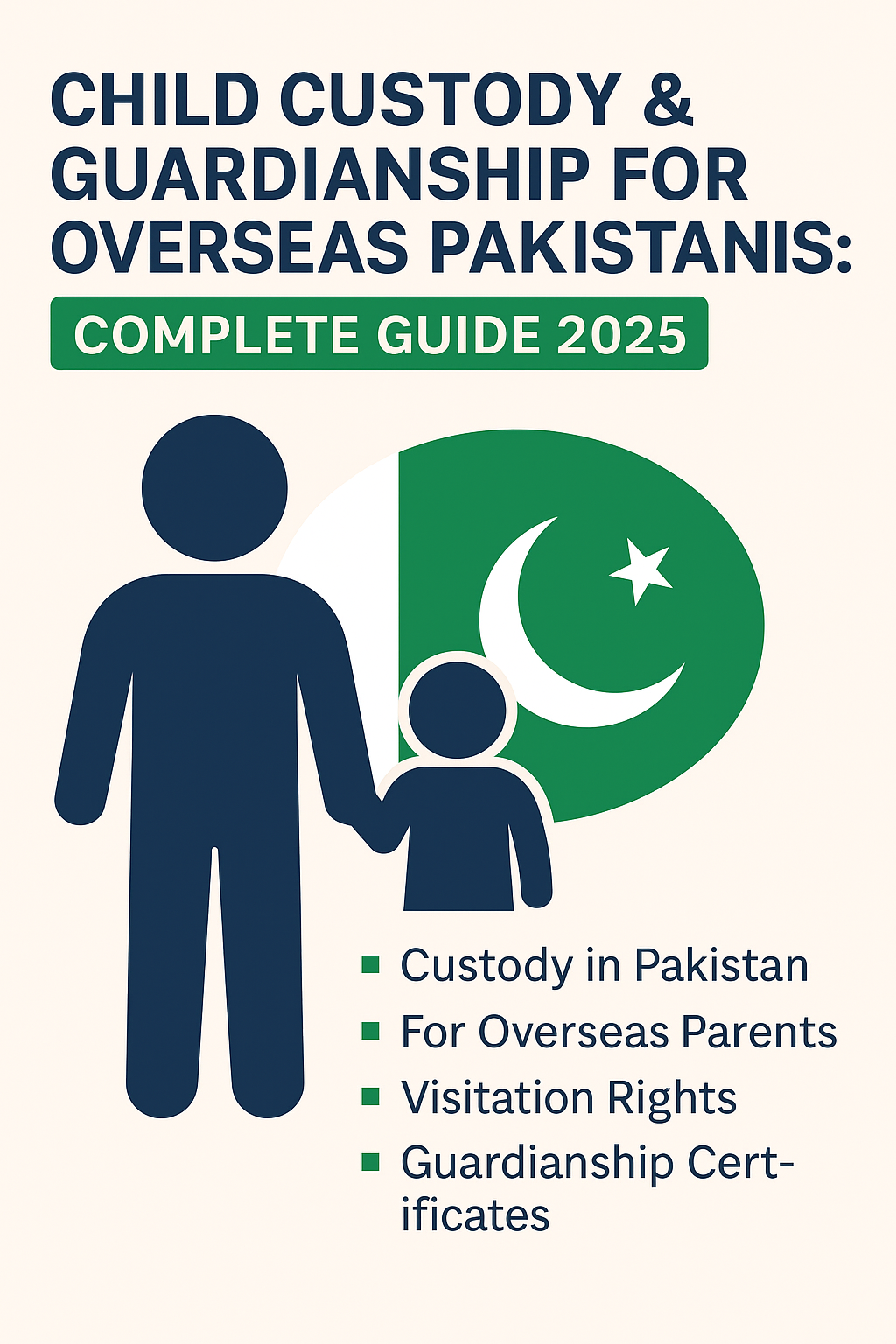
Child Custody & Guardianship for Overseas Pakistanis: Complete Guide 2025

Child Custody for Overseas Pakistanis

Child Custody for Overseas Pakistanis

Child custody disputes are among the most sensitive legal issues, especially when one or both parents live abroad. For Overseas Pakistanis, understanding how custody and guardianship are decided under Pakistani law is crucial. The Guardian & Wards Act, 1890 governs custody, ensuring that the welfare of the minor is always the primary consideration.

This guide explains the child custody process for overseas Pakistanis, interim and permanent custody orders, visitation rights, and how a Power of Attorney can help parents manage cases without traveling to Pakistan.

Legal Framework for Child Custody in Pakistan

Child custody and guardianship fall under the Guardian & Wards Act, 1890.

  • The Family Court has jurisdiction over custody disputes.

  • The best interest of the child is the overriding factor.

  • Custody may be granted to either parent or, in some cases, grandparents/relatives.

Custody Process for Overseas Pakistani Parents

1. Filing a Custody Case

  • A parent can file a petition for custody in the Family Court where the child resides.

  • Overseas parents can appoint a lawyer in Karachi through Power of Attorney.

2. Interim Custody Orders

  • Courts often grant interim custody (temporary arrangement) until final judgment.

  • Example: Allowing mother interim custody of minor children until trial concludes.

3. Permanent Custody Orders

  • After evaluating evidence, living conditions, and welfare of the child, the court passes a final custody order.

Visitation Rights for Overseas Parents

  • Even if custody is not granted, the non-custodial parent is entitled to visitation rights.

  • For overseas parents:

    • In-person meetings during visits to Pakistan.

    • Video call visitation orders (increasingly recognized by courts).

    • Extended visitation during summer/winter vacations.

Role of Power of Attorney in Custody Cases

  • Overseas parents need not travel back for every hearing.

  • A Special Power of Attorney allows a lawyer or relative to represent them in court.

  • This ensures active participation while minimizing travel costs.

Guardianship Matters

In addition to custody, parents may also need guardianship certificates to:

  • Manage minor’s property or inheritance.

  • Apply for passports and international travel.

  • Take decisions for education or health abroad.

The Family Court grants guardianship after ensuring the welfare of the child.

Why Hire a Lawyer in Karachi?

  • Expertise in Family Court procedures.

  • Ensures custody or visitation rights are effectively pursued.

  • Drafts and registers Power of Attorney for overseas parents.

  • Prevents delays or adverse judgments due to absence.

Contact Us Today!

For Overseas Pakistanis, pursuing child custody or guardianship in Pakistan is possible without returning home. By appointing a trusted lawyer in Karachi and using Power of Attorney, parents can safeguard their rights and ensure the welfare of their children remains protected.

child custody overseas Pakistanis, guardianship cases in Pakistan, visitation rights for overseas Pakistanis, family court child custody Pakistan, child custody lawyer Karachi, overseas parents custody Pakistan, interim custody orders Pakistan, guardian and wards act Pakistan, overseas Pakistani family disputes, child custody law Pakistan.

Frequently Asked Questions (FAQs)

Can an overseas Pakistani parent file for child custody in Pakistan?

Yes, custody petitions can be filed in Family Courts through a lawyer using Power of Attorney.

How do courts decide custody in Pakistan?

Courts prioritize the welfare of the minor, considering education, health, and overall upbringing.

Can overseas parents get visitation rights?


Yes. Courts may allow in-person meetings during visits to Pakistan or even video call visitations.

What is the difference between custody and guardianship?


Custody refers to the child’s daily care, while guardianship is legal authority over property, travel, or important decisions.

Do I need to come to Pakistan for custody hearings?


No. You can appoint a lawyer in Karachi through a Special Power of Attorney to handle proceedings on your behalf.

Divorce & Khula Process for Overseas Pakistanis

Divorce & Khula Process for Overseas Pakistanis

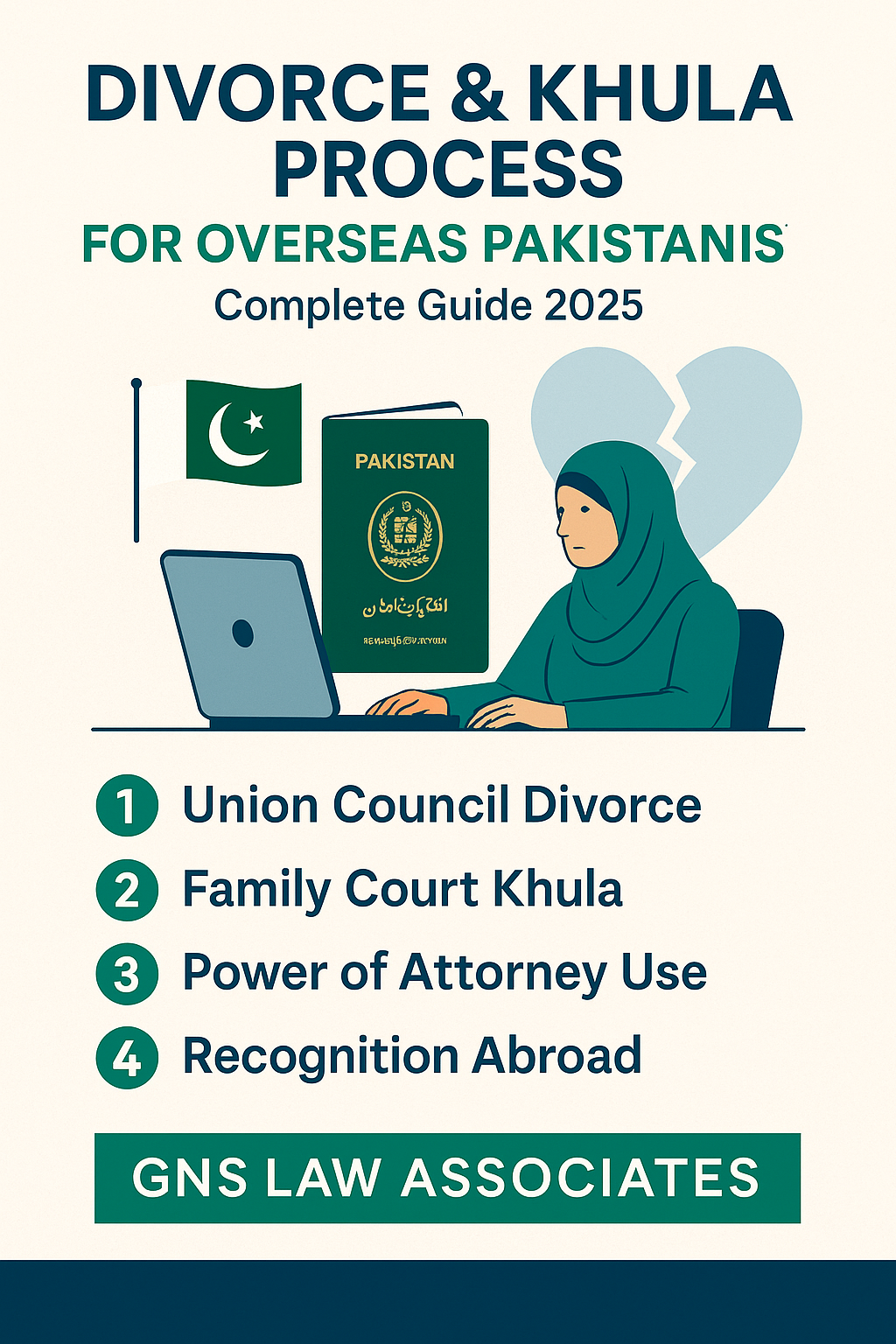
Divorce & Khula Process for Overseas Pakistanis: Complete Guide 2025

Divorce & Khula Process for Overseas Pakistanis

Divorce & Khula Process for Overseas Pakistanis

Overseas Pakistanis often face difficulties when it comes to dissolving a marriage under Pakistani law. Whether you are a husband initiating divorce (Talaq) or a wife seeking separation through Khula, the procedures in Pakistan are legally binding—even if you live abroad.

This guide explains the step-by-step divorce and khula process for overseas Pakistanis, the role of Union Councils, Family Courts, Power of Attorney, and how to ensure your divorce or khula is legally recognized both in Pakistan and abroad.

Divorce Procedure for Overseas Pakistani Husbands

Under the Muslim Family Laws Ordinance, 1961, a husband has the right to pronounce divorce (Talaq).

Steps for Overseas Divorce (Talaq):

  1. Written Notice of Divorce

    • The husband must issue a written divorce notice and send it to the Chairman of Union Council in the wife’s jurisdiction in Pakistan.

  2. Union Council Proceedings

    • The Union Council issues notices to both parties.

    • A conciliation period of 90 days begins to explore reconciliation.

  3. Issuance of Divorce Certificate

    • If reconciliation fails, the Union Council issues an official NADRA Divorce Certificate after 90 days.

  4. Use Abroad

    • For overseas use, the divorce certificate must be attested by MOFA Pakistan and the Pakistani Embassy/Consulate.

Khula Process for Overseas Pakistani Wives

If a wife wants to dissolve marriage without the husband’s consent, she can file for Khula in Family Court.

Steps for Overseas Khula:

  1. Appointing a Lawyer / Power of Attorney

    • The wife may appoint a lawyer in Karachi via Power of Attorney to file the case in Family Court.

  2. Filing of Suit for Khula

    • The petition is filed stating reasons such as incompatibility, cruelty, desertion, or lack of maintenance.

  3. Court Proceedings

    • The court records the wife’s statement.

    • The husband is given the opportunity to respond.

  4. Decree of Khula

    • If reconciliation is not possible, the court grants Khula through a Family Court decree.

    • After Khula, the Union Council issues a NADRA divorce certificate.

Power of Attorney in Divorce & Khula Cases

Overseas Pakistanis are not required to travel back. Instead, they can:

  • Execute a Special Power of Attorney at their nearest Pakistan Embassy/Consulate.

  • Authorize a lawyer or family member in Karachi to appear on their behalf.

  • This ensures the case proceeds without delays.

Recognition of Divorce/Khula Abroad

  • Embassy Attestation: Divorce/NADRA certificates must be attested by MOFA and the Pakistan Embassy/Consulate.

  • Foreign Legalization: Some countries require additional legalization under local laws.

  • Dual Recognition: The divorce/khula decree is valid in Pakistan and can be used abroad once properly attested.

Why Hire a Lawyer in Karachi?

  • Correct filing of Union Council notices and court petitions.

  • Representation through Power of Attorney.

  • Ensuring documentation is valid for both Pakistan and overseas jurisdictions.

  • Legal safeguards against procedural errors or fraud.

Contact Us Today!

For overseas Pakistanis, navigating the divorce and khula process in Pakistan requires proper legal guidance. Whether through Union Councils or Family Courts, the law ensures fairness but also demands compliance with procedural steps. With the help of experienced lawyers in Karachi, overseas Pakistanis can finalize their divorce or khula smoothly without the need to travel back.

divorce procedure for overseas Pakistanis, khula process in Pakistan from abroad, divorce certificate for overseas Pakistanis, khula in Pakistan through power of attorney, overseas Pakistani family law, union council divorce overseas Pakistan, family court khula procedure Karachi, divorce lawyer for overseas Pakistanis, Pakistani divorce law for expats, online khula process Pakistan

Frequently Asked Questions (FAQs)

Can I get a divorce in Pakistan while living abroad?

Yes. You can issue a divorce notice to the Union Council through a lawyer or POA without traveling to Pakistan.

How long does the divorce process take in Pakistan?

The Union Council requires a mandatory 90-day reconciliation period. After that, the divorce certificate is issued.

Can a wife get Khula without her husband’s consent?


Yes. A wife can approach the Family Court, and if reconciliation fails, the court grants Khula without the husband’s consent.

Do I need to appear in court for Khula if I live abroad?


No. You can appoint a lawyer in Karachi through Power of Attorney to handle proceedings on your behalf.

How do I use a Pakistani divorce certificate abroad?


The certificate must be attested by MOFA Pakistan and the Pakistan Embassy/Consulate for overseas recognition.

Power of Attorney for Overseas Pakistanis

Power of Attorney for Overseas Pakistanis

Power of Attorney for Overseas Pakistanis: Complete Guide 2025

Power of Attorney for Overseas Pakistanis

Power of Attorney for Overseas Pakistanis

Power of Attorney for Overseas Pakistanis

Overseas Pakistanis often face challenges when managing their property, business, or family matters in Pakistan. Traveling back for every legal or financial requirement is costly and time-consuming. The most practical solution is to issue a Power of Attorney (POA) to a trusted family member, lawyer, or agent in Pakistan.

This blog explains the types, procedures, legal requirements, and uses of Power of Attorney for Overseas Pakistanis, with a special focus on Karachi courts and consular processes.

What is a Power of Attorney?

A Power of Attorney (Wakalat Nama) is a legal document through which one person (the Principal) authorizes another person (the Attorney/Agent) to act on their behalf in legal, financial, or personal matters.

Types of Power of Attorney in Pakistan:

  • General Power of Attorney (GPA):
    Grants wide powers such as managing property, selling assets, appearing in court, or handling banking matters.

  • Special Power of Attorney (SPA):
    Limited authority for a specific task, such as selling one property, filing one case, or representing in one proceeding.

Why Overseas Pakistanis Need POA

  • Property matters: Selling, purchasing, or transferring property.

  • Court representation: Filing or defending lawsuits without traveling to Pakistan.

  • Banking & Finance: Operating accounts, withdrawing funds, or clearing liabilities.

  • Succession & Inheritance: Applying for succession certificate, letter of administration, or property mutation.

  • Family matters: Marriage registration, divorce/khula, or child custody cases.

Legal Procedure for Overseas Pakistanis to Execute POA

  1. Draft the POA

    • Must be clear, specific, and stamped as per Pakistani law.

    • Better to engage a lawyer in Karachi to draft it properly.

  2. Attestation at Pakistan Embassy/Consulate

    • Visit the nearest Pakistan Embassy/Consulate in your country.

    • Carry CNIC/NICOP, valid passport, and 2–3 photographs.

    • The Embassy will verify and attest the POA.

  3. Send to Pakistan

    • Courier the attested POA to Pakistan.

    • Attach CNIC copies of both Principal and Attorney.

  4. Verification in Pakistan

    • Submit the POA to the Ministry of Foreign Affairs (MOFA), Pakistan for further attestation.

    • Present it before the local Sub-Registrar / Court depending on usage (property transfer, court case, etc.).

  5. Legal Effect

    • After verification, the Attorney can act on behalf of the Principal in Pakistan.

Common Mistakes Overseas Pakistanis Should Avoid

  • Using vague or overly broad terms in the POA.

  • Not attesting the POA from the Pakistan Embassy.

  • Giving POA to untrustworthy relatives (leading to fraud/illegal transfers).

  • Failing to limit time duration or scope in Special POA.

Why Hire a Lawyer in Karachi for POA?

  • Proper Drafting: Lawyers ensure that the document is valid under the Power of Attorney Act 1882 & Registration Act.

  • Legal Safeguards: Clauses are added to prevent misuse.

  • Court Filing: Lawyers can directly present POA before the court/registrar.

  • Overseas Convenience: You avoid travel while ensuring legal compliance.

Contact Us Today!

A Power of Attorney is a lifeline for Overseas Pakistanis managing their affairs in Pakistan. Whether it is property, inheritance, or litigation, a properly drafted and attested POA saves time, cost, and stress. At GNS Law Associates, we assist overseas Pakistanis in drafting, attesting, and registering POAs in Karachi, ensuring their rights remain protected.

Power of Attorney in Pakistan for overseas Pakistanis, General Power of Attorney overseas Pakistanis, Special Power of Attorney Pakistan, Embassy attestation Power of Attorney, Power of Attorney procedure in Karachi, MOFA attestation Power of Attorney, Pakistani property Power of Attorney overseas, How to make Power of Attorney abroad for Pakistan, Lawyer in Karachi for Power of Attorney

Frequently Asked Questions (FAQs)

Can I give Power of Attorney while living abroad?

Yes, you can execute a POA at your nearest Pakistan Embassy/Consulate. After attestation and MOFA verification in Pakistan, it becomes legally valid.

What is the difference between General and Special POA?

General POA covers broad powers (property, banking, court), while Special POA is limited to one matter only.

Do I need to visit Pakistan to register my POA?


No, you can complete the process abroad with Embassy attestation and send it to Pakistan for verification.

How long does it take to validate a POA in Karachi?


Normally 1–2 weeks after submission to MOFA and the Sub-Registrar/Court.

Can POA be misused in Pakistan?


Yes, if not drafted carefully. Always limit the scope and appoint a trustworthy attorney. Legal safeguards can be added by lawyers.